
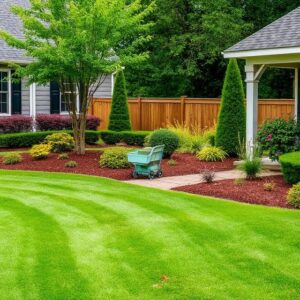
 Choosing the right grass for your Raleigh lawn is one of the most important landscaping decisions you will make — and one of the most confusing. Raleigh sits in the transition zone, a region where both cool-season and warm-season grasses can grow but neither is perfect year-round. Pick the wrong grass for your property’s sun exposure, soil type, and usage patterns and you will fight an uphill battle every season. Pick the right one and your lawn practically takes care of itself.
This guide breaks down the four most common grass types in Raleigh, explains what each one needs to thrive, and helps you decide which is the best fit for your property.
What Makes Raleigh a Transition Zone
The transition zone runs roughly from central North Carolina across Tennessee, through northern Georgia, and into parts of the mid-Atlantic. In this band, winters are cold enough to stress warm-season grasses and summers are hot enough to stress cool-season grasses. Raleigh sits right in the heart of it.
What this means practically is that tall fescue stays green all winter but can thin out and develop brown patch during July and August. Bermuda thrives in the summer heat but turns completely brown after the first hard frost and does not green up again until late April or May. No single grass type gives you a perfect lawn twelve months a year in Raleigh — but understanding the tradeoffs lets you choose the one that best fits your priorities.
Tall Fescue — The Year-Round Green Option
Tall fescue is the most widely planted cool-season grass in the Triangle. Its biggest advantage is year-round green color — while your neighbor’s Bermuda lawn turns brown from November through April, a well-maintained fescue lawn stays green through winter. Tall fescue also handles partial shade better than any warm-season grass, making it ideal for Raleigh’s tree-lined neighborhoods where mature oaks and maples cast significant shade.
The tradeoff is summer vulnerability. Tall fescue is susceptible to brown patch disease during Raleigh’s hot, humid summers, especially when nighttime temperatures stay above 70 degrees and the grass stays wet from evening irrigation or afternoon thunderstorms. Prevention starts with mowing at 3 to 4 inches — never below 3 — and watering deeply but infrequently in the morning rather than the evening.
Tall fescue is a bunch-type grass, which means it does not spread by runners. Bare spots will not fill in on their own. Annual overseeding in September is essential to maintain a thick, dense fescue lawn in Raleigh.
Best for: Shaded properties, homeowners who want year-round green, established neighborhoods with mature tree canopy.
Bermuda — The Heat and Traffic Champion
Bermuda is the dominant warm-season grass in Raleigh’s full-sun properties. It thrives in summer heat, handles heavy foot traffic, and recovers from damage faster than any other grass type in our market. Bermuda spreads aggressively by stolons and rhizomes, filling in bare spots quickly and choking out most weeds once established.
The tradeoff is winter dormancy. Bermuda goes completely brown after the first hard frost, typically in late October or November, and does not green up until soil temperatures consistently reach 65 degrees in late April or May. That is five to six months of brown lawn. Some homeowners overseed Bermuda with perennial ryegrass in fall for winter color, but this adds cost and management complexity.
Bermuda also needs full sun — at least 6 to 8 hours of direct sunlight per day. It thins rapidly in shade and is a poor choice for properties with significant tree canopy.
Mow Bermuda at 1 to 2 inches during the growing season. It is an aggressive grower that needs frequent mowing — often twice per week during peak summer growth.
Best for: Full-sun properties, high-traffic yards with kids and pets, homeowners who prioritize summer performance over winter appearance.
Zoysia — The Middle Ground
Zoysia offers a compromise between fescue and Bermuda. It handles heat and drought better than fescue, tolerates partial shade better than Bermuda, and creates a dense, fine-textured turf that feels great underfoot and resists weeds naturally. Zoysia is slower to establish than Bermuda but requires less maintenance once it fills in.
Like Bermuda, Zoysia goes dormant in winter — but its dense growth habit means the dormant turf holds its structure better than Bermuda’s, creating a tan carpet rather than a patchy brown lawn. Zoysia greens up slightly earlier than Bermuda in spring, typically in mid-April.
Mow Zoysia at 1.5 to 2.5 inches. It is slower growing than Bermuda and needs less frequent mowing during summer.
Best for: Homeowners who want a warm-season grass with better shade tolerance than Bermuda, moderate-traffic yards, properties with mixed sun and shade.
Centipede — The Low-Maintenance Option
Centipede is sometimes called “the lazy man’s grass” because it requires less fertilization and mowing than any other warm-season option. It grows slowly, stays low, and tolerates poor soil — but it has specific requirements that make it a niche choice in Raleigh.
Centipede requires acidic soil with a pH below 6.0. Raleigh’s Piedmont clay tends to be moderately acidic, which works for centipede, but if your soil has been limed heavily in the past, centipede will struggle. It also has poor traffic tolerance and does not recover well from heavy use.
Mow centipede at 1 to 2 inches. Over-fertilizing centipede is one of the most common mistakes — it actually performs worse with heavy fertilization.
Best for: Low-traffic areas, homeowners who want minimal maintenance, properties with naturally acidic soil.
How to Choose the Right Grass for Your Raleigh Property
The decision comes down to three factors: sun exposure, traffic, and winter appearance preference.
If your property has significant shade from mature trees, tall fescue is your best option. If your property gets full sun all day and you prioritize summer performance, Bermuda is the answer. If you want something in between — decent shade tolerance with warm-season heat performance — Zoysia is the compromise. If you want absolute minimum maintenance and have low-traffic areas with acidic soil, centipede works.
Many Raleigh properties benefit from using more than one grass type — fescue in shaded areas and Bermuda or Zoysia in full sun. Our planning assesses your property’s specific conditions and recommends the right grass for each area.
Contact Raleigh Pro Landscape at (919) 823-6150 for a free lawn assessment. We will evaluate your property’s sun exposure, soil type, and usage patterns and recommend the grass type that will give you the best results with the least effort.
Raleigh yard plan step
Use the article to document evidence, responsibility, and the handover condition for the request.