
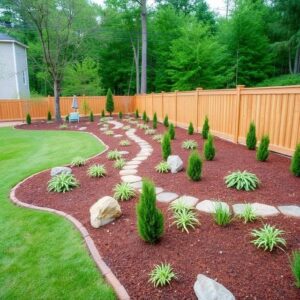
 If you have ever tried to dig a hole in your Raleigh backyard after a dry spell, you know exactly what Piedmont clay feels like — hard, dense, and unforgiving. If you have tried to dig after a heavy rain, you know the other side of clay — sticky, waterlogged, and impossible to work with. This dual personality is what makes clay soil the central challenge in almost every landscaping project in Wake County.
Understanding how clay behaves — and how to work with it instead of against it — is the difference between a landscape that thrives and one that struggles from day one.
What Is Piedmont Clay and Why Does It Matter
The Piedmont region of North Carolina — stretching from the coastal plain to the foothills — sits on ancient metamorphic and igneous bedrock that has weathered over millions of years into heavy clay soil. This clay is composed of extremely fine mineral particles that pack tightly together, creating soil that holds water near the surface, drains slowly, and compacts under foot traffic and equipment.
For landscaping, this means three things. First, plant roots have difficulty penetrating compacted clay, limiting how deep and wide root systems can grow. Second, water pools on the surface and in planting beds after rain because the clay will not absorb it quickly. Third, clay expands when wet and contracts when dry, creating a cycle of soil movement that can crack hardscape, heave retaining walls, and push plants out of the ground.
Most of Raleigh sits on this clay. Properties in Cary, Apex, Wake Forest, Garner, and throughout Wake County have the same soil profile. The depth and density of the clay varies by location, but the fundamental challenge is consistent across the Triangle.
Drainage — The Number One Issue on Clay Soil
Poor drainage is the most common landscaping problem on Raleigh clay. After a heavy thunderstorm, water sits on the surface for hours because the clay absorbs it so slowly. This standing water drowns plant roots, promotes fungal disease in turf, and turns low-lying areas into muddy swamps.
The solution is not to fight the clay — it is to move water away from problem areas before it has a chance to pool. Proper grading directs surface water away from your home’s foundation and toward designated drainage areas. French drains collect subsurface water and route it to safe discharge points. Dry creek beds handle surface flow during heavy rain events while adding a natural design element to the landscape. Channel drains along hardscape edges prevent water from pooling on patios and walkways.
Every landscape design we produce for a Raleigh property includes a drainage assessment as a standard part of the process. If we do not address drainage first, nothing else we plant or build will perform the way it should.
Amending Clay Soil for Planting Beds
You cannot change the fundamental nature of Piedmont clay, but you can improve the top layer of soil in your planting beds to give plants a better growing environment. The goal is to increase organic matter, improve drainage in the root zone, and create a transition layer between the amended bed soil and the native clay below.
We amend planting beds by incorporating 3 to 4 inches of quality compost into the top 8 to 12 inches of soil. This breaks up the clay structure, adds organic matter that holds nutrients and moisture in a plant-available form, and creates air pockets that allow roots to grow and water to move. For particularly heavy clay, we may add expanded slate or pine bark fines to further improve drainage.
One critical mistake to avoid: do not simply dig a hole in clay, fill it with good soil, and drop a plant in. This creates what landscape professionals call a “bathtub effect” — the amended soil in the hole holds water while the surrounding clay prevents it from draining. The plant essentially sits in a waterlogged pocket and drowns. Proper amendment means blending the new material into the existing clay so there is a gradual transition rather than a sharp boundary.
Building Hardscape on Raleigh Clay
Clay’s expansion and contraction cycle is the enemy of hardscape installations. A patio built directly on clay will heave in winter when the saturated clay expands during freeze events, and settle unevenly in summer when the clay contracts and cracks during dry spells. Within two to three years, you will see joint separation, uneven surfaces, and cracked pavers.
Proper hardscape construction on clay requires excavating through the clay layer to a stable subgrade — typically 8 to 12 inches below finished grade depending on the application. A layer of geotextile fabric goes down to prevent clay from migrating up into the aggregate base. Then 6 to 8 inches of compacted crushed stone provides a stable, well-draining foundation that does not move with the clay beneath it. Proper drainage behind retaining walls is equally critical — clay does not allow water to drain laterally, so hydrostatic pressure builds behind walls and pushes them over if drainage provisions are not built into the wall system.
This base preparation adds cost to hardscape projects compared to markets with sandy or loam soils. But it is not optional in Raleigh. A contractor who skips base preparation to save you money is actually costing you more — because you will pay again when the work fails.
Lawn Care on Clay Soil
Clay affects lawn care in ways most Raleigh homeowners do not realize until they see the symptoms. Compacted clay restricts root growth, which makes turf thin, weak, and vulnerable to heat stress, drought stress, and disease. Water sits on the surface after irrigation instead of soaking in, leading to runoff and wasted water. Heavy clay also stays cooler in spring, which delays warm-season grass green-up compared to properties with lighter soil.
The single most effective treatment for compacted clay under turf is core aeration — pulling plugs of soil out of the ground to create channels for air, water, and roots. We recommend aerating fescue lawns in fall and Bermuda or Zoysia lawns in late spring. Annual aeration on Raleigh clay makes a noticeable difference in turf health, density, and color within one growing season.
Topdressing with compost after aeration accelerates soil improvement by introducing organic matter directly into the root zone through the aeration holes. Over time, this gradually transforms the top few inches of soil from dense clay into a more workable growing medium.
Working With Clay Instead of Against It
The key insight about Raleigh’s clay soil is that it is not a problem to solve — it is a condition to manage. Every design decision, every plant selection, every hardscape installation, and every irrigation schedule needs to account for how clay behaves. Designers and contractors who understand this build landscapes that look better, last longer, and cost less to maintain over time.
Contact Raleigh Pro Landscape at (919) 823-6150 for a free property assessment. We will evaluate your soil conditions and recommend solutions designed specifically for your property’s clay.
Raleigh yard plan step
Use the article to document evidence, responsibility, and the handover condition for the request.