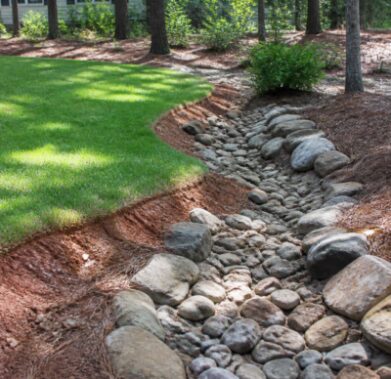
What should the irrigation proposal document for Raleigh?
Before approving a Raleigh irrigation proposal, give the provider dimensions, current observations, access details, objectives, and questions. The returned document must distinguish included work, owner duties, contingencies, and completion review.
Raleigh Pro Landscape designs, installs and repairs irrigation in Raleigh and across Wake County: sprinkler systems for turf, drip for beds, controller upgrades and seasonal tune-ups. A new system on a typical lot runs $2,500 to $5,000, about $500 to $850 a zone. Call and we’ll walk the yard and quote it in writing.
Call (919) 823-6150 or request a free written quote. Tell us whether you’re on Raleigh Water or another town’s system, and whether the sprinklers have their own meter. Both change what the city expects from you, and this page walks through it.
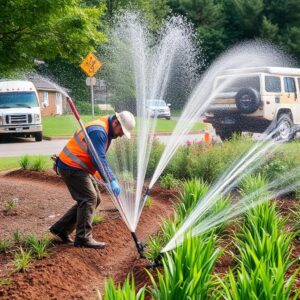
How much does an irrigation system cost in Raleigh?
A new sprinkler system for a typical Raleigh lot runs $2,500 to $5,000, usually $500 to $850 per zone with six to eight zones on an average property. Bigger lots with seven or more zones run $5,000 to $6,500 and up. Drip for beds runs $1,500 to $4,000, and most repairs land between $100 and $400.
| Work | Typical Raleigh range |
|---|---|
| New sprinkler system, six to eight zones | $2,500 to $5,000 |
| Larger system, seven or more zones, mixed turf and beds | $5,000 to $6,500 and up |
| Drip irrigation for beds | $1,500 to $4,000 |
| Smart controller upgrade | $200 to $500 |
| Repairs and zone adjustments | $100 to $400 |
| Backflow test | $75 to $150 |
Those are the 2026 figures from our Raleigh landscaping cost guide and cost page. What moves a quote inside the range:
- Zone count. More lawn, more beds and more sun-versus-shade splits mean more zones.
- Clay and roots. Trenching through dry red clay and around mature tree roots is slower than trenching open ground.
- Water source. Tying into the house line is different work than setting up a separate irrigation meter.
- Controller. A weather-based controller costs a little more up front. On our clay, with our water rules, it’s worth it.
- Drip versus spray in beds. Drip takes more parts and labor per square foot, and it uses less water once it’s in.
How much water does a Raleigh lawn actually need?
About 1 inch a week in the growing season, rain included. NC State Extension’s long-term table for the Raleigh area shows that irrigation only has to make up part of that: roughly 2 to 3 inches a month for tall fescue from April through August, and less for bermuda and zoysia.
Here are NC State’s numbers for the Raleigh area. They’re the inches of irrigation a well-kept lawn needs on top of average rainfall. Nothing is called for from November through March.
| Month | Cool-season turf (tall fescue) | Warm-season turf (bermuda, zoysia) |
|---|---|---|
| April | 2.18 in | 1.36 in |
| May | 2.67 in | 1.76 in |
| June | 2.93 in | 1.92 in |
| July | 2.83 in | 1.76 in |
| August | 2.60 in | 1.63 in |
| September | 1.93 in | 1.25 in |
| October | 1.26 in | 0.85 in |
| Season total | 16.40 in | 10.53 in |
Two things jump out. A fescue lawn needs about half again as much irrigation over a season as a bermuda lawn. And none of these numbers is large. A system that runs every zone 30 minutes a day is putting down several times what the grass can use. It takes 640 gallons to put 1 inch of water on 1,000 square feet, so overwatering shows up on the bill fast.
How long should each sprinkler zone run on Raleigh clay?
Shorter than most controllers are set. NC State’s Raleigh table assumes three waterings a week. In June, a fescue zone putting down 1 inch per hour needs about 15 minutes per run, and a bermuda zone about 10. On clay, even that should be split into two shorter cycles.
| Zone output | Fescue, June | Fescue, September | Bermuda, June | Bermuda, September |
|---|---|---|---|---|
| 0.5 inch per hour | 29 min | 19 min | 19 min | 13 min |
| 1.0 inch per hour | 15 min | 10 min | 10 min | 6 min |
| 1.5 inches per hour | 10 min | 6 min | 6 min | 4 min |
Those runtimes are per watering, three times a week, from NC State’s Table 14 for the Raleigh area. Here’s why clay changes how you deliver them:
- Clay drinks slowly. NC State says few lawns on clay can absorb more than 0.5 inch of water per hour. Plenty of zones put water down faster than that, so the extra runs off.
- Cycle and soak. The fix is to water until runoff is about to start, wait 30 minutes, then water again. A decent controller does this on its own once it’s programmed.
- Water at night. The most efficient window is 10 p.m. to 8 a.m. For fescue, watering between 2 a.m. and 8 a.m. also cuts the risk of brown patch.
- Check coverage. An irrigation audit measures how evenly a zone waters. NC State calls a distribution uniformity near 0.7 good, and says a system under 0.5 needs adjusting.
- Check depth. Push a screwdriver or probe into the soil after a cycle. You want water down 4 to 6 inches, not a wet surface over dry clay.
We set every controller we touch this way. More on the soil itself is on our Raleigh soil guide.
What does our irrigation installation process look like, step by step?
Eight steps: a site walk, a water-source check, a zone design, a written quote, trenching and pipe, heads and drip, the backflow assembly and controller, and a walkthrough. You approve the zone plan and the price before a trench is opened. Most home systems go in over a few working days, weather and clay permitting.
- Site walk. We measure turf and beds, mark sun and shade, note slopes, and find the wet and dry corners. You tell us what has to stay green and what can go without.
- Water source. We find the meter, check whether the system will branch off the house line or run on its own irrigation meter, and note the pressure. This decides pipe sizes and zone count.
- Zone design. Turf and beds go on separate zones. So do full sun and shade, and fescue and bermuda. You see the plan on paper and can move or drop zones.
- Written quote. Each zone, the controller, the backflow assembly and any drip are separate lines.
- Trenching and pipe. Utilities get marked before any digging. Main and lateral lines go in, and trenches are backfilled and tamped so the lawn doesn’t settle into ruts.
- Heads and drip. Rotors for open turf, sprays for small panels, drip line in beds. Heads are set to the grade so a mower clears them.
- Backflow assembly and controller. The backflow assembly goes in right after the meter. The controller gets programmed for cycle-and-soak, overnight runs, and a rain sensor or soil moisture sensor.
- Walkthrough. We run every zone with you, show you the controller, and tell you what the city requires for testing and when.
Is a drip irrigation system worth it in Raleigh?
For beds, shrubs and trees, yes. Drip puts water at the root zone instead of throwing it through the air, it keeps foliage dry in our humid summers, and under Raleigh’s Stage 1 restrictions in 2026 it stayed legal every day while sprinklers were cut to one. It runs $1,500 to $4,000 for bed areas.
Where drip earns its keep around here:
- Foundation beds. Spray heads against a house wet the siding and the windows. Drip line under the mulch waters the shrubs and nothing else.
- Clay. Drip applies water slowly, which is how clay wants it. There’s nothing to run off.
- Restrictions. During Stage 1, drip and handheld watering were allowed any day at any time. A yard with its beds on drip rode out the summer without losing plants.
- New plantings. Raleigh gave no automatic watering exemption for landscaping installed after April 20, 2026. Drip was the legal way to establish it.
- Narrow strips. Between a walk and a wall, or along a driveway, sprays mostly water the pavement. NC State’s water-wise design guidance is blunt about it: avoid watering buildings, driveways, streets and sidewalks.
Drip isn’t for lawns, and it does need a filter and a pressure regulator and an occasional flush. We convert existing spray zones in beds to drip, or run new drip zones off the same controller. If you’re redoing the beds anyway, plan the drip with the planting. Our landscape design page covers that.
What are Raleigh’s rules on irrigation backflow testing?
An irrigation system on Raleigh Water has a backflow assembly, and city code requires it to be tested by a City of Raleigh Certified Tester. Home systems are due by July 1 every three years. Commercial systems are due by July 1 every year. Skip it and a metered irrigation service gets disconnected.
The backflow assembly sits outside, right after the water meter. It keeps water that’s picked up fertilizer or pet waste in the yard from flowing back into the public supply. Here’s what the city’s Cross Connection program says:
- Who tests. Only a City of Raleigh Certified Tester, at the customer’s expense. The city keeps the list. It also advises confirming the tester is licensed to repair or replace the assembly if it fails.
- When. By July 1. Reports can be submitted up to five months ahead, so the spring start-up visit is the natural time.
- If you don’t. A non-compliant metered irrigation system is disconnected, and there’s a $50 fee each time service is restored. A system that branches off the house line gets a $100 non-testing fee on the water bill.
- Records. The owner keeps written records of tests and repairs for at least three years.
- Shutting a system down for good. A branched system has to be formally deactivated or terminated with the city, or the testing notices keep coming.
This applies beyond Raleigh city limits. Raleigh Water also serves Garner, Knightdale, Wake Forest, Rolesville, Wendell and Zebulon. Cary, Apex, Holly Springs and other towns run their own utilities with their own rules, so we check yours. We’ll tell you when your test is due and what the city wants to see.
What do Raleigh water restrictions mean for a sprinkler system?
Right now, nothing. The City of Raleigh lifted Stage 1 on August 3, 2026. But restrictions follow Falls Lake, not the calendar, and from April 20 to August 3 in-ground sprinklers were limited to one assigned day a week. A system should be set up so the next stage is a button press.
| Under Stage 1 in 2026 | Allowed day | Allowed hours |
|---|---|---|
| In-ground sprinklers, odd address | Tuesday | Midnight to 10 a.m. |
| In-ground sprinklers, even address | Wednesday | Midnight to 10 a.m. |
| Hose-end sprinkler | Your assigned day | 6 to 10 a.m. or 6 to 10 p.m. |
| Drip and handheld hose | Any day | Any time |
| Private well | Exempt | Exempt |
What we take from that when we design or reprogram a system:
- Save a restriction program. A second schedule on the controller, one day a week, done before 10 a.m., ready to switch on.
- Put what matters on drip. Trees, shrubs and perennials cost more to replace than turf, and drip kept running.
- Think twice about an irrigation-only meter. Stage 2 carries disconnection of irrigation-only service, and City Council gave the City Manager faster authority to escalate on July 7, 2026.
- Don’t go back to the old schedule. Raleigh’s use ran about 69 million gallons a day before restrictions and about 60 million during them. Nearly all of that gap was outdoor watering.
The current stage and the full history are on our Raleigh watering restrictions page.
When should a sprinkler system be started up and winterized in Raleigh?
Start it up after the last frost, which is around mid-April here, and shut it down before the first one in early November. In between, check it mid-summer when heat and mowers have had a go at the heads. NC State’s Raleigh table calls for no irrigation at all from November through March.
| When | Visit | What gets done |
|---|---|---|
| Mid to late April | Spring start-up | Backflow assembly reinstalled, lines pressurized, every zone run, heads straightened, controller set for spring. Backflow test if it’s due. |
| July | Mid-season check | Coverage and leaks checked, nozzles cleaned, runtimes raised to summer numbers, rain sensor tested. |
| September | Seeding schedule | For fescue lawns being overseeded: short, frequent cycles to keep seed moist, then back to deep and infrequent. |
| Late October to early November | Winterization | Water shut off, lines drained or blown out, backflow assembly drained and protected from freezing. |
The fall timing matters twice. Raleigh winters are mild, but a backflow assembly full of water will still split in a hard freeze, and it isn’t a cheap part to replace. And September is when a fescue lawn gets reseeded, so the controller has to change jobs for a few weeks. Our planting and overseeding guide covers the watering side of that.
What goes wrong with sprinkler systems here, and what does repair cost?
Mostly small things that add up: heads knocked crooked or buried by a mower, clogged nozzles, a valve that won’t close, a wire nicked by a shovel, and a controller still running last summer’s schedule. Repairs and zone adjustments run $100 to $400. A controller swap runs $200 to $500.
- Tilted and sunken heads. Clay swells wet and shrinks dry. Over a few seasons that movement shifts heads off level and they stop covering their arc.
- Overspray. Heads watering the driveway or the street. It’s wasted water, and during a restriction stage it’s the first thing a neighbor notices.
- Leaks at fittings and valves. A soggy spot that never dries, or a zone that weeps after it shuts off.
- Dry corners. Usually a spacing or pressure problem from the original install. Sometimes fixed with a nozzle change, sometimes with an added head.
- Mixed zones. Sprays and rotors on one valve, or turf and beds together. One of them is always getting the wrong amount.
- Old timers. A fixed-schedule clock with no rain sensor waters in the rain. NC State’s design guidance is a multi-zone system with a rain sensor or soil moisture monitor.
If you just bought a house with a system nobody’s explained to you, a tune-up visit is the place to start. We run every zone, map it, and hand you a list with a price next to each fix.
What do typical irrigation jobs look like around Raleigh?
These are typical scopes, not past jobs, priced from our published ranges. A newer subdivision lot, an older in-town lot with deep beds, and a big lot with mixed sun each get a different system. The lot decides the design more than the square footage does.
- A typical quarter-acre fescue lot in a newer subdivision, like those around Brier Creek or Wakefield. Six to eight zones: rotors on the open front and back lawn, sprays on the side strips, one drip zone for the foundation beds, a weather-based controller. $2,500 to $5,000, and a few working days on site.
- A typical older lot with mature trees and deep beds, the kind you find near Five Points. Small lawn, lots of roots, shade nearly everywhere. Often no turf zones at all: drip through the beds for $1,500 to $4,000 and a hose bib for the rest.
- A typical large lot in North Raleigh or Wake Forest with full sun out front and woods behind. Seven or more zones, with sun and shade split and the slope zones on short cycles. $5,000 to $6,500 and up.
- A typical tune-up on an existing system. Every zone run, heads straightened and raised, nozzles matched, controller reprogrammed for cycle-and-soak. $100 to $400, plus $200 to $500 if the controller is replaced.
Do you handle irrigation for HOAs and commercial properties?
Yes. Entrances, common areas, parking lot islands and building beds. Commercial systems carry a tighter rule in Raleigh: the backflow assembly has to be tested every year by July 1, not every three. Common areas on irrigation-only meters are also the first thing shut off if the city reaches Stage 2.
The scope and the city’s landscaping rules for commercial sites are on our commercial landscaping page. Weekly turf care is on the lawn mowing page, and patios, walls and drainage are under hardscaping.
Where do you install and repair irrigation?
All of Raleigh, from Five Points and North Hills to Brier Creek and Wakefield, plus Cary, Apex, Holly Springs, Fuquay-Varina, Garner, Knightdale, Morrisville and Wake Forest. We also work in Durham and Chapel Hill. Tell us your town when you call, since the water utility and its rules change with it.
The full list is on our areas we serve page. Call (919) 823-6150 or request a free quote, and we’ll come run the zones with you.
Who can legally install an irrigation system in Raleigh, NC?
North Carolina General Statute 89G requires irrigation construction and irrigation contracting to be done under the direct supervision of an individual licensed by the NC Irrigation Contractors’ Licensing Board. Property owners working on their own land are exempt. Anyone bidding to install your system should be able to name that licensed individual.
The statute is public at ncleg.gov, Chapter 89G. For the Raleigh-specific side of a project, start with the landscaping permits guide.
How do I choose an irrigation installation company in Raleigh?
Ask who holds the irrigation contractor license behind the crew, then ask for a zone-by-zone written scope. Check that the backflow assembly and controller are separate lines, and compare at least two bids built on the same zone count. A bid that cannot be broken down by zone cannot be compared.
Before you collect bids, it helps to know how restrictions can affect a system. The history and current status are on our Raleigh watering restrictions page.
How much does irrigation installation cost in Raleigh?
Our Raleigh cost page lists a new four to six zone system at $3,000 to $5,000 and larger systems of seven or more zones at $5,000 to $6,500 and up. Drip for beds runs $1,500 to $4,000. Zone count, clay and tree roots, and the water source move a quote inside those ranges.
These are typical ranges, not quotes for your yard. The full table sits on the Raleigh landscaping cost page, and the quote form gets you a number for your lot.
What should an irrigation quote in Raleigh include?
A solid quote lists each zone, the controller, the backflow assembly, any drip lines for beds, and what is excluded. It should say who handles the water-source connection and which licensed irrigation contractor supervises the work. Lines you can read one by one are lines you can negotiate.
Planning beds and irrigation together saves rework. The landscape design page shows how drip zones are laid out with the planting plan.
Which yard plan elements support a property request for Irrigation?
Before approving a Raleigh irrigation proposal, give the provider dimensions, current observations, access details, objectives, and questions. The returned document must distinguish included work, owner duties, contingencies, and completion review.
“Our Raleigh crew runs Irrigation across Wake County every week. Same teams, same schedule, same standard.”— Raleigh Pro Landscape Operations Team
- Professionally managed local crews on dedicated weekly routes
- Serving multiple Wake County suburbs on fixed route schedules
- Operator-grade scheduling and reporting
- Free written estimates on every job