How should Raleigh commercial landscape work be scoped?
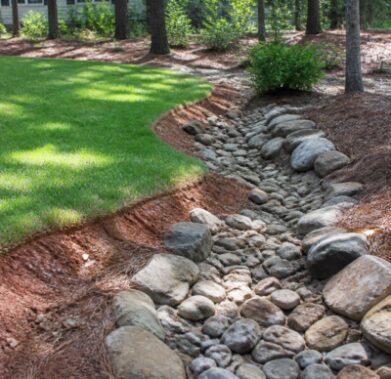
Piedmont clay, shaded turf transitions, sloping runoff, established trees, and Raleigh Water requirements can change the work at a Wake County site. Record maintained square footage, drainage duties, seasonal tasks, and exclusions before evaluating proposals.
Raleigh Pro Landscape takes on commercial landscaping in Raleigh and Wake County for HOAs, office sites, retail centers and apartment communities. We don’t publish a flat monthly rate, because the price follows measured turf, bed area and visit count. Call, we walk the site, and you get a written, line-item proposal.
Call (919) 823-6150 or request a free site walk and quote. Have a site plan or a plat handy if you’ve got one. If the property went through City of Raleigh site plan review, bring the approved landscape plan too. It’s the document the city holds you to, and most maintenance bids never look at it.
How much does commercial landscaping cost in Raleigh?
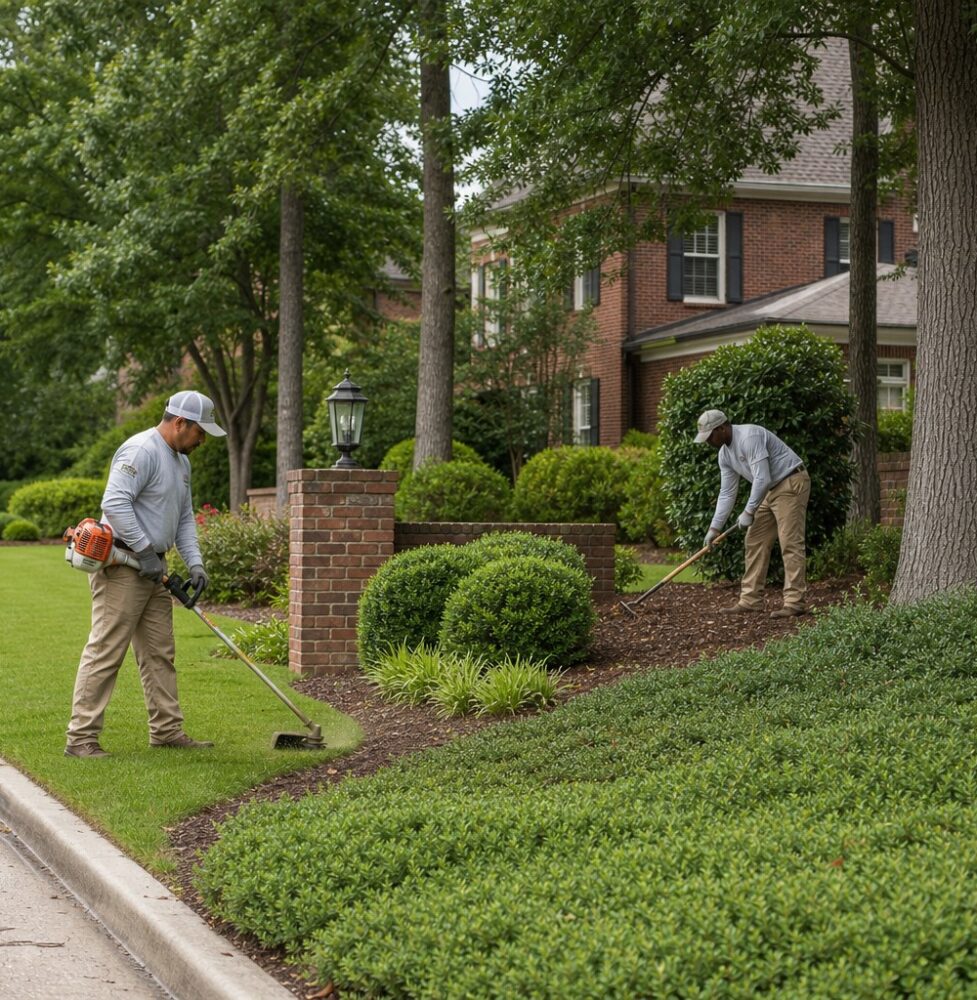
It’s priced per site, not per month off a chart. Turf acreage, bed square footage, the number of visits, irrigation zones and how much seasonal color you want decide the number. We measure those on a site walk and price each one as its own line, so you can compare bids and cut scope without guessing.
We won’t print a monthly contract range here, because any figure that covers both a one-entrance HOA and a multi-building office park is too wide to help you. What we can show is unit pricing. These are the 2026 ranges from our own Raleigh landscaping cost page and cost guide. They’re published for home-scale jobs, and they’re the same line items that show up on a commercial enhancement proposal:
| Line item | Published Raleigh range |
|---|---|
| Mulch, installed | $55 to $90 per cubic yard |
| Seasonal color or flower bed refresh | $300 to $1,200 per bed |
| Irrigation repair or zone adjustment | $100 to $400 |
| Irrigation backflow test | $75 to $150 |
| Drip irrigation for beds | $1,500 to $4,000 |
| French drain or drainage fix | $1,500 to $5,000 |
| Sod, installed with soil prep | $1.50 to $3.00 per sq ft |
| Retaining wall | $30 to $60 per sq ft of wall face |
What moves a recurring contract up or down:
- Mowable turf, and which grass it is. Fescue and bermuda peak in opposite seasons, so a mixed site gets two calendars.
- Bed area and plant count. Beds are hand work. They cost more per square foot than turf.
- Visit frequency. Weekly in the growing season is standard. Winter visits drop off.
- Parking lot islands and curb line. Lots of small islands mean lots of trimmer time and blowing.
- Slope, ponds and natural areas. Pond banks and wooded buffers have their own rules in Raleigh, covered below.
- Disposal. In most Wake County towns a contractor has to haul the yard waste it generates. That’s in our price, not a surprise later.
What does commercial landscape management in Raleigh cover?
Mowing, edging and blowing on a set schedule, bed and shrub care, mulch, seasonal color, irrigation checks, leaf removal, fall aeration and overseeding on fescue, and storm cleanup. On a Raleigh site it also covers keeping the landscaping your approved site plan requires alive and in its natural form, because city code puts that on the owner.
| Service | What it involves here | Timing |
|---|---|---|
| Mowing, edging, blowing | Tall fescue held at 3.5 inches in summer and 2.5 to 3 inches in fall. Bermuda kept between 1 and 2.5 inches. | Weekly in season. Fescue may need cutting every five to seven days in late spring. |
| Bed maintenance and pruning | Weeding, edging, shrub pruning that keeps each plant’s natural form. | Every visit for beds. Pruning by species. |
| Mulch | Hardwood mulch or pine straw refreshed in beds and tree rings. | Once a year, usually late winter or spring. |
| Seasonal color | Annuals at entrances, signs and courtyards. | Changed out in spring and fall. |
| Aeration and overseeding | Core aeration on compacted clay, then turf-type tall fescue seed. | September, mid-October at the latest. Bermuda is aerated in late spring or early summer instead. |
| Irrigation checks | Head-by-head run-through, controller schedule, leaks, backflow test reminder. | Spring start-up, mid-summer, fall shut-down. |
| Leaf removal | Lawn, beds, lots, curb line and drain inlets cleared and hauled. | November through February. |
| Storm cleanup | Downed limbs and debris cleared from drives, walks and lots. | As needed. |
The mowing heights aren’t ours. They come from NC State Extension’s maintenance calendars for tall fescue and bermudagrass. Related service pages: lawn mowing, irrigation, leaf removal and hardscaping.
What does our commercial landscaping process look like, step by step?
Seven steps: a site walk, a measured zone map, a written scope with a frequency on every task, your approval, a first cleanup visit, the recurring schedule, and a seasonal review. You decide scope and frequency at step three. Nothing starts until the scope is in writing and you’ve signed off on it.
- Site walk. We walk every entrance, island, bed, pond bank and buffer with you or your property manager. A small retail pad takes well under an hour. A multi-entrance HOA can take a morning.
- Zone map. The site gets split into named zones, such as front entrance, building beds, parking islands, pond edge and rear buffer, with turf and bed areas measured for each.
- Written scope. Each zone gets its tasks and a frequency. You see what’s weekly, what’s monthly, what’s seasonal, and what’s excluded. You decide where to spend and where to cut back.
- Proposal and approval. One document: scope by zone, price by line, the contract period, and how out-of-scope work gets approved before it’s done.
- First visit. Often the longest one. Overgrown beds get reset, edges re-cut, and debris hauled so the recurring visits start from a clean baseline.
- Recurring visits. Same scope, same order, each scheduled visit. Problems we spot, like a broken head, a dead shrub or a washout, get reported to you with a price instead of quietly billed.
- Seasonal review. Before fall and before spring we go over aeration, overseeding, color change-outs, mulch and any city-required replacements, so the big items are approved ahead of their window.
What does HOA landscape maintenance in Raleigh include?
Entrances and monument signs, common-area turf, street edges, pool and clubhouse beds, walking trail edges, pond banks and the buffers along the property line. For an HOA board, the scope also has to match the community’s own standards, and it has to be written plainly enough that the next board can read it.
A few things are specific to HOAs around here:
- Master-planned standards. In Cary, Apex and Holly Springs, HOA landscape standards can dictate materials, lawn condition and bed upkeep. We build the scope around the community’s documents, not around a generic checklist.
- Fescue common areas. Most Triangle lawns are tall fescue. It can’t fill its own thin spots, so the fall aeration and overseeding is the line item a board shouldn’t cut. September is the window.
- Leaves. The City of Raleigh ended loose-leaf vacuum collection and moved to weekly cart-and-bag yard waste pickup on September 8, 2026. For common areas, that means leaves get hauled. Our leaf removal page lists each town’s rules.
- Architectural review. When an entrance or common area gets redesigned, we prepare the submittal as part of the plan. See landscape design.
- Irrigation on a separate meter. Many common areas run on irrigation-only service. That matters under Raleigh’s water rules, covered below.
Which Raleigh rules does a commercial property owner have to keep up with?
More than most owners realize. Raleigh’s Unified Development Ordinance makes the owner or tenant responsible for keeping required landscaping healthy, sets a deadline for replacing dead plants, and fines excessive tree pruning. Parking lots, ponds, tree conservation areas and irrigation backflow assemblies each carry their own rule. Here’s the short version.
| Topic | What the rule says |
|---|---|
| Required landscaping | The owner or tenant must maintain all required landscaping in good health. Dead, unhealthy or missing plants must be replaced within 30 days, or within 180 days where weather would put new plants at risk (UDO Sec. 7.2.7). |
| Storm losses | If required landscaping is severely damaged by an unusual weather event, the owner may have 2 years to replace it. |
| Pruning | Required landscaping must be allowed to reach its required size and can’t be trimmed so its natural form is impaired. Removing more than 25% of a tree’s crown within a continuous 5-year period counts as excessive trimming. |
| Penalty | A civil penalty of at least $1,000 for the first tree, plus $100 per caliper inch for any other tree unlawfully pruned or damaged. Replacement trees must be at least 3-inch caliper and 10 feet tall. |
| Parking lots | In lots with more than 10 spaces, a landscaped interior island every 10 spaces, each with at least one shade tree, and no less than one shade tree per 2,000 square feet of parking area (UDO Sec. 7.1.7). |
| Plant choices | Plants must be hardy to zone 7 and able to survive on natural rainfall once established. No North Carolina invasive species may be used to meet a requirement. |
| Sight lines | Landscaping can’t block a motorist’s view at any street, driveway, parking aisle or intersection approach. |
| Erosion | Planting areas must be stabilized from soil erosion immediately upon planting and kept that way. |
| Tree conservation | Parcels of 2 acres or more going through subdivision or a Tier 2 or Tier 3 site plan must set aside tree conservation area: 10% of net site area in most districts, 15% in R-1 and R-2 (UDO Secs. 9.1.2 and 9.1.3). |
| Stormwater ponds | New or substantially modified retention ponds and detention basins must be screened unless they’re built with amenity features. Lose a qualifying feature and it has to be restored within 30 days (UDO Sec. 7.2.6). |
| Grading | A land disturbance permit is required when 12,000 square feet or more is disturbed. |
| Irrigation backflow | Containment assemblies on commercial irrigation systems must be tested every year by July 1 by a City of Raleigh Certified Tester. |
Why it matters for a maintenance contract: a crew that shears every crape myrtle and willow oak to the same height can put you on the wrong side of the pruning rule, and a dead shrub in a required buffer starts a 30-day clock. We read the approved landscape plan first, flag what’s required, and keep a running list of replacements for your approval. These are City of Raleigh rules. Cary, Apex, Wake Forest and the other towns have their own, and we check the code for the town your site is in.
How do Raleigh water rules affect a commercial irrigation system?
Two ways. First, the backflow assembly on a commercial irrigation system has to pass a test by a City of Raleigh Certified Tester every year by July 1, or a metered irrigation service gets disconnected. Second, drought stages can limit or cut off irrigation, as they did from April 20 to August 3, 2026.
The details, from the city’s own pages:
- Non-compliance has a price. A non-compliant metered irrigation system will be disconnected, with a $50 fee each time service is restored. A non-compliant branched system gets a $100 non-testing fee on the water bill.
- Test reports can go in early. Irrigation reports may be submitted up to five months before the July 1 due date, so spring start-up is the sensible time.
- Keep records. The owner has to keep a written record of testing and repairs for at least three years.
- Stage 1 came and went. Under Stage 1, in-ground sprinklers ran one assigned day a week, midnight to 10 a.m. Drip and handheld watering stayed legal every day.
- Stage 2 is harsher. The ordinance City Council approved on July 7, 2026 lets the City Manager escalate faster, and Stage 2 carries disconnection of irrigation-only service. A common area that lives on an irrigation-only meter has a single point of failure.
So we set commercial controllers to run overnight, cycle-and-soak on clay, and put beds on drip where the budget allows. NC State Extension says the most efficient window is 10 p.m. to 8 a.m., and that on clay the system should be cycled, water then soak, to keep water from running off. Our Raleigh watering restrictions page tracks the current stage.
How should fescue and bermuda be handled on the same commercial site?
As two separate lawns. Raleigh sits in the transition zone, so plenty of sites have fescue in the shade of the buildings and bermuda out by the road. Fescue is mowed high, seeded in fall and babied through summer. Bermuda is mowed low, fed in summer, and left alone once it goes dormant.
| Task | Tall fescue | Bermuda |
|---|---|---|
| Summer mowing height | 3.5 inches | 1 to 2.5 inches |
| Core aeration | Fall, with overseeding | Late spring or early summer |
| Overseeding | September 1 to October 1 in the Piedmont | Not seeded in fall |
| Main disease watch | Brown patch in humid weather above 85 degrees | Spring dead spot at green-up |
| Winter | Stays green. Mow to 3 inches and remove leaves. | Dormant and brown. Leaf removal helps earlier green-up. |
Brown patch is the one to watch on fescue. NC State’s guidance is to keep the mowing height above 3 inches and water between 2 a.m. and 8 a.m. A crew that scalps fescue to bermuda height in July is setting the lawn up to fail. More on the trade-offs is on our Raleigh grass types page.
What does a typical commercial scope look like?
It depends on the property type. These are typical scopes, not past jobs, written to show how the line items change from an HOA to a retail center to an office site. Prices for the one-time items come from our published ranges. The recurring price is always quoted from your measured site.
- A typical HOA in a master-planned community. Two entrances with monument signs, a clubhouse, a pond and a mile of street edge. Weekly mowing and edging in season, entrance color changed twice a year at $300 to $1,200 a bed, mulch once a year at $55 to $90 a cubic yard, fall aeration and overseeding on the fescue, leaves hauled November through January.
- A typical retail center. Mostly parking lot. A dozen or more interior islands with a required shade tree in each, a street-front hedge, and a couple of sign beds. Weekly trimming and blowing, shrubs kept at their required size instead of sheared down, dead plants in required islands replaced inside the 30-day window.
- A typical office site of 2 acres or more. Building beds, a fescue lawn, a rear tree conservation area and a detention basin. The conservation area is left alone. The basin bank gets mowed on its own schedule, and the irrigation backflow test gets done before July 1.
- A typical apartment community. Lots of small turf panels between buildings, heavy foot traffic, and dog areas. Bed edges and walk edges every visit, aeration on the compacted panels, and drainage fixes at $1,500 to $5,000 where downspouts wash out the beds.
How are leaves, storm debris and yard waste handled on commercial sites?
We haul them. Most Wake County towns won’t collect yard waste that a contractor generated. Apex, Holly Springs, Fuquay-Varina, Garner, Knightdale and Morrisville say so on their own public works pages. Inside Raleigh, loose-leaf vacuum collection ended in 2026. So the disposal line is part of every commercial proposal we write.
On a commercial lot, the first thing cleared is the curb line and the drain inlets. Leaves matted over an inlet turn a Piedmont thunderstorm into a flooded parking row. After a storm, drives and walks come first, then turf and beds.
Which property types and areas do you serve?
HOAs and master-planned communities, office sites, retail centers, apartment and townhome communities, medical offices and industrial properties. We work across Raleigh and Wake County, including Cary, Apex, Holly Springs, Fuquay-Varina, Garner, Knightdale, Morrisville and Wake Forest, and we take commercial sites in Durham and Chapel Hill.
The full list of towns is on our areas we serve page. To get a proposal started, call (919) 823-6150 or request a free site walk. Send the site plan ahead if you have it, and we’ll show up with the required landscaping already marked.
What is commercial landscape maintenance in Raleigh?
Commercial landscape maintenance is recurring, scheduled care of non-residential grounds: mowing, edging, beds, irrigation checks, seasonal color, leaf removal and storm cleanup. In Raleigh it is priced per site from measured turf, bed area and visit count, not from a flat chart, so every property gets its own written scope.
The lawn mowing page shows how a single visit is itemized, and the same structure scales up to a full property.
Which properties need commercial landscaping in Raleigh?
HOAs, office sites, retail centers and apartment communities are the usual clients. Any property that went through City of Raleigh site plan review also has an approved landscape plan the owner is held to, which makes steady upkeep a compliance matter as well as an appearance one.
If your community spans several towns, the areas we serve page lists where routes run.
How often should commercial grounds in Raleigh be serviced?
Weekly during the growing season is standard, with winter visits thinning out. Tall fescue can need cutting every five to seven days in late spring, per NC State Extension, while bermuda peaks in summer. A site with both grasses runs on two calendars, so the schedule should be written by zone.
Fall is when the big seasonal items land. See the leaf removal page for how cleanup fits the schedule.
Does a Raleigh property expansion trigger landscaping requirements?
It can. Under Raleigh’s Unified Development Ordinance, an increase of up to 25% in floor area or improved site area requires landscaping for the added area only. An increase of more than 25% means the existing use and the addition must both conform to the landscaping rules.
This is Sec. 7.2.2 of the UDO on the City’s site. Confirm how it applies to your parcel with Raleigh Development Services, and use the quote form if you want the maintenance scope priced alongside it.
What should a commercial landscaping contract in Raleigh spell out?
It should list each zone with its tasks and frequency, what is excluded, the contract period, and how out-of-scope work gets approved before it is done. Fixed unit prices for extras like mulch, color changes and irrigation repair keep the budget predictable and make bids easy to compare.
Irrigation responsibility is the line most contracts leave vague. Our irrigation page explains what a system check covers.
Which yard plan elements support a property request for Commercial Landscaping?
A Raleigh commercial scope can account for Piedmont clay, shaded turf transitions, sloping runoff, established trees, and Wake County stormwater constraints. Record square footage and seasonal tasks so reviewers can trace each proposal item to the property.
“Our Raleigh crew runs Commercial Landscaping across Wake County every week. Same teams, same schedule, same standard.”— Raleigh Pro Landscape Operations Team
- Professionally managed local crews on dedicated weekly routes
- Serving multiple Wake County suburbs on fixed route schedules
- Operator-grade scheduling and reporting
- Free written estimates on every job