
Last updated: October 6, 2026
Short answer: Artificial turf in Raleigh counts as 100% impervious under the City’s residential stormwater FAQ unless a professional engineer designs it as a permanent stormwater control measure. The UDO’s separate built-upon-area term treats turf that drains through its backing over a pervious surface as 0%. Get the classification for your address in writing before buying.
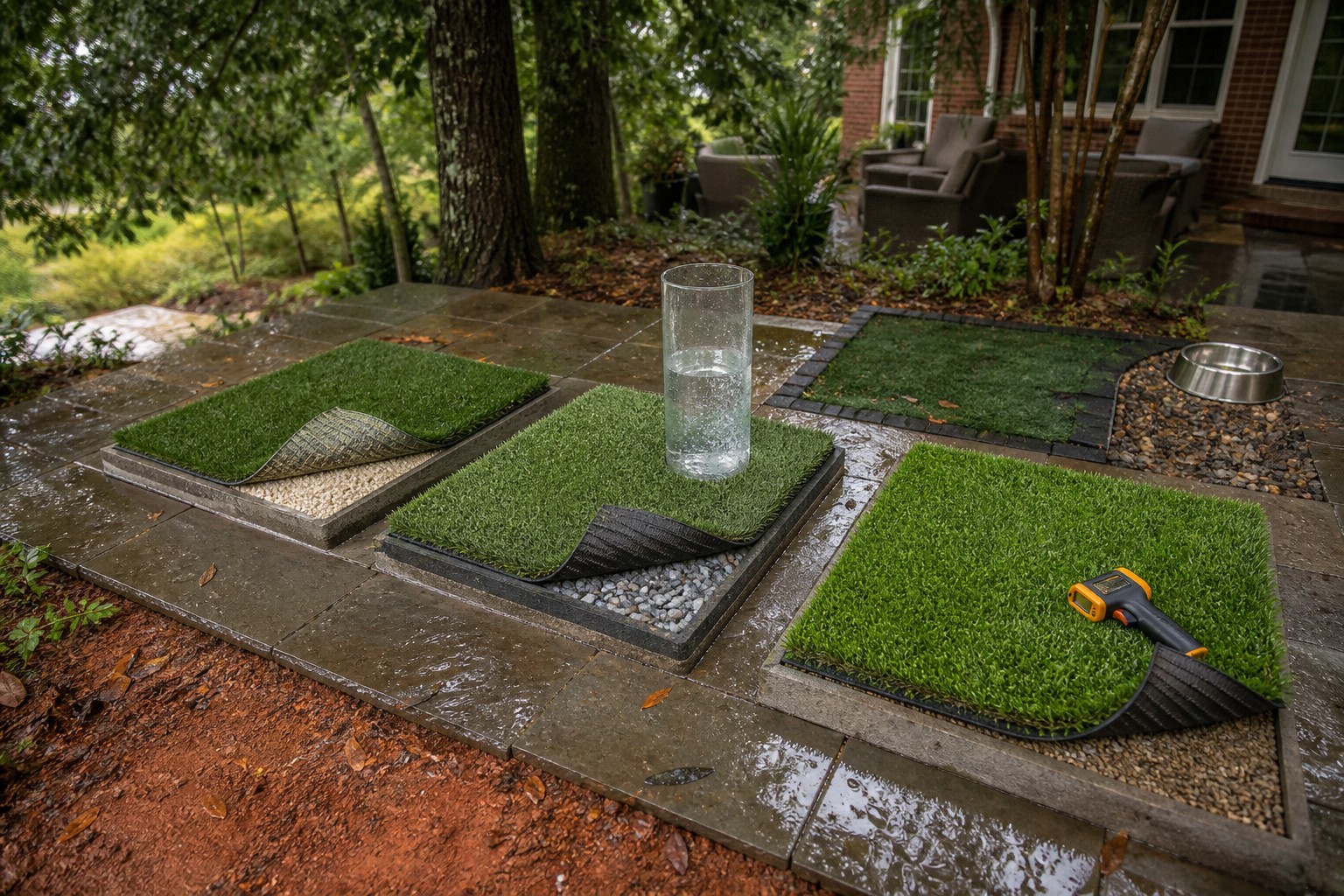
Artificial turf is sold as a finished green surface. A Raleigh property owner needs to buy something more complicated: a layered drainage assembly, a summer-use surface, a stormwater classification, a cleaning program, and an eventual removal job. The visible fibers may be the least consequential part.
That reframing matters on Piedmont clay and under humid summer sun. A perforated backing can drain quickly in a product demonstration while the compacted base below stores water. A sample can feel acceptable in a showroom while becoming unusable for a dog at midday. A proposal can call the system permeable while the City applies a different term or documentation standard.
Is artificial turf considered impervious surface in Raleigh?
Usually, yes. The residential stormwater FAQ treats it as 100% impervious unless it’s engineered and handled like a permanent stormwater control measure under UDO Section 9.2.2. Section 9.2.1 uses a different term, built-upon area, and rates turf that drains through its backing, installed to manufacturer specifications over a pervious surface, at 0%. Ask Raleigh Stormwater which calculation applies.
Raleigh’s residential stormwater FAQ says artificial turf is considered 100% impervious unless it is designed by a professional engineer and treated like a permanent stormwater control measure under UDO Section 9.2.2. The City’s impervious-surface overview also lists artificial turf among common examples and notes that a survey or plot plan with existing and proposed calculations may be required for residential permitting.
The current Raleigh UDO uses a separate term, built-upon area. Section 9.2.1 says artificial turf manufactured to drain through its backing, installed to manufacturer specifications, and placed over a pervious surface is 0% built-upon area. Those words create an assembly test: the backing, installation, and surface below must all satisfy the stated condition.
Do not convert either passage into a universal sales claim. Ask Raleigh Stormwater to state in writing which calculation applies to the address, intended scope, and exact section through the system. Supply the product data, square footage, base profile, existing and proposed impervious-area table, outlet, and site plan. Record whether the answer concerns permitting, zoning, utility-fee mapping, a watershed limit, or a permanent control measure.
If a salesperson says “permeable,” ask which municipal term that statement satisfies and what evidence proves it after installation. A material property is not automatically a project approval.
Does artificial turf drain well on Raleigh clay?
Only as well as the slowest layer beneath it. Water has to pass through the fibers and backing, move through the base, enter the native subgrade, and leave without ponding. NC State Extension describes clayey soil as slow-draining and compaction-prone, so a backing flow rate alone proves nothing locally. Test the prepared subgrade and a finished bay.
Water must pass through the fibers and backing, remain mobile through the base, reach or enter the native subgrade, and leave without ponding, erosion, polluted discharge, or flow onto neighboring property. The slowest layer controls the observed result.
NC State Extension describes clayey soil as slow-draining, compaction-prone, and potentially subject to shrink-and-swell behavior. A turf conversion often adds excavation traffic and a compacted aggregate layer precisely where infiltration is expected. That does not prove every system will fail; it means a backing flow rate alone is not local evidence.
Expose the proposed profile in the quote: fiber and thatch structure, backing perforation, infill, pad if any, base gradation and depth, separator, native soil, slope, edge restraint, collection pipe if used, and lawful receiving location. Map downspouts, irrigation, tree roots, low spots, neighboring runoff, foundations, drains, and easements before choosing grade.
Test the prepared subgrade before covering it. Then test a representative completed bay with the same seams, edges, infill, slope, and base as the work. Observe both controlled water and a real rainfall. Bank the water volume or event timing, ponding duration, outlet behavior, sediment, seam response, and photographs from fixed points.
| Claim in a proposal | Decision-grade evidence | Failure signal |
|---|---|---|
| “Fast draining” | Full-assembly field test over the actual prepared subgrade | Backing passes water but base or clay remains saturated |
| “Pet friendly” | Written cleaning protocol, urine route, heat test, and odor correction terms | Cleaner voids warranty or rinse water has nowhere to go |
| “Cooler technology” | Side-by-side sample temperatures at the use hours and exposures | Acceptable morning sample becomes unusable in afternoon sun |
| “Long lasting” | Product-specific warranty plus seam, edge, drainage, and wear acceptance triggers | Years are promised without defining acceptable appearance or performance |
How should I test artificial turf for summer heat?
Put real samples, with the intended infill and base, in the full-sun and shade spots where the turf will go. Record air temperature, cloud cover, time, and surface temperature, plus a nearby patch of living turf for comparison. NC State’s Constructed Facilities Laboratory describes synthetic fields as sometimes unusable because of heat, so treat it as a design issue.
NC State’s Constructed Facilities Laboratory describes synthetic fields as sometimes unusable because of heat and is studying water-reservoir and evaporative-cooling assemblies. That research is about specialized field systems, not proof that a residential lawn sample will perform the same way. It does establish that heat is a system-design issue rather than a fiber-color footnote.
Place actual samples in the proposed full-sun and shade locations. Include the intended infill and base, because a loose swatch on concrete is not the installed assembly. Record air temperature, cloud cover, time, surface temperature, shade movement, wet or dry condition, and the temperature of nearby living turf or another usable surface.
Define who uses the area and when. A decorative strip viewed from indoors has a different acceptance threshold from a barefoot play zone, dog run, preschool yard, pool route, or work area. If cooling requires routine watering, include that water, drainage, labor, and operating restriction in the comparison rather than continuing to describe the surface as water-free.
For pets, NC State veterinary guidance recommends favoring cooler grass, cooler times of day, shade, water, and a hand-contact check when outdoor surfaces are hot. A dog-run plan should always preserve a shaded alternative and an exit route; the installed turf should not become the only surface available.
Is artificial turf a good choice for dogs?
That depends on liquid management more than the label. A pet-turf name doesn’t say where urine goes, how solids come out, which cleaners are compatible, or how odor gets corrected. Ask the manufacturer for allowed cleaners and rinse requirements, and ask the installer which layers are reachable if odor persists. Run a test bay before converting the whole yard.
“Pet turf” does not answer where urine goes, how solids are removed, what cleaner is compatible, or how an odor problem is corrected. Document the number and size of animals, use frequency, shade, hose access, drainage destination, surrounding walls, air movement, and whether runoff could reach planting beds or storm infrastructure.
Ask the manufacturer to identify allowed and prohibited cleaners, rinse requirements, dwell time, infill maintenance, and warranty consequences. Ask the installer to name the accessible components if odor persists: infill, fiber, pad, base, edge, drain, or contaminated native soil. A corrective method that cannot reach the affected layer is not a remedy.
Use a test bay in the planned location before converting the whole yard. Include normal pet use and the proposed cleaning routine through hot, humid, and rainy conditions. Accept based on observable odor, drainage, cleanability, seam stability, edge security, and surface temperature—not on a product-category label.
Shade solves one problem and creates other questions
Tree shade can reduce solar exposure, but turf construction can threaten the tree that supplies it. Excavation, grade change, compaction, root cutting, and removal of living root-zone cover can all matter. Map trunk, canopy, major visible roots, irrigation, and proposed cut depth before laying out the synthetic area.
A dense canopy also adds leaves, twigs, pollen, seed, fruit, sap, and wildlife debris. These materials can settle into fibers, collect at edges, or obstruct surface openings. The maintenance plan needs equipment that removes debris without damaging fibers or exporting infill.
Do not make a full-yard choice by comparing synthetic turf only with struggling tall fescue. Raleigh sits in a turf transition zone with different living grasses, and some sites are better served by a smaller functional lawn, adapted planting, mulch, permeable path, or mixed design. Use the existing Raleigh grass comparison and the broader site design process to define which square feet genuinely need a wear surface.
Specify materials without making blanket safety claims
Synthetic turf systems vary. Residential landscape turf, playground surfacing, putting material, and athletic fields may use different fibers, backing, pads, and infills. Federal tire-crumb research applies to systems containing recycled tire material; it should not be copied onto a different assembly as either proof of danger or proof of safety.
Require the exact manufacturer, product code, fiber polymer, backing, infill type, pad, adhesives, seam materials, edge materials, recycled content, safety data sheets where applicable, test reports, and country of manufacture. Record substitutions before installation. “Lead-free,” “PFAS-free,” “non-toxic,” “antimicrobial,” and similar claims need a named test method, laboratory, lot or product coverage, date, and detection basis.
Ask what wears away and where it goes. High-traffic fibers, infill migration, edging, leaf-blower use, and cleaning discharge all belong in the maintenance record. The answer may be product-specific; the point is to prevent an undefined environmental promise.
Buy an acceptance test, not a lifespan slogan
No universal years figure captures Raleigh sun, shade, pets, traffic, tree litter, red-clay drainage, seam count, edge conditions, cleaning chemistry, and maintenance. A long warranty can also exclude the very causes most likely on the site.
Translate longevity into written thresholds. Define acceptable drainage time, seam separation, edge lift, wrinkles, fiber loss, flattening, infill migration, color change, odor, weeds, settlement, exposed base, and surface temperature. State who inspects, who corrects, whether repair restarts any coverage, and what happens if the base—not the carpet—is responsible.
Build a lifecycle ledger without invented pricing. Include survey or plan work, municipal review, removal, excavation, soil disposal, tree protection, base, drainage, turf, infill, cooling or rinse water, debris removal, brushing, cleaner, infill replenishment, seam repair, stormwater-device inspection if applicable, and end-of-life removal and disposal. Compare that ledger with the current Raleigh watering context and the maintenance of a smaller, correctly selected living-turf area.
At handoff, bank the City’s written classification, approved calculation or plan if required, product submittals, installed section, concealed-stage photographs, base and infiltration tests, heat log, pet test if relevant, maintenance procedure, warranty, correction contacts, and disposal assumptions. The result is not “maintenance free.” It is a surface whose obligations are visible before they become sunk cost.
Raleigh artificial-turf Sources
- City of Raleigh: residential stormwater FAQ and artificial-turf impervious-surface treatment
- City of Raleigh: impervious-surface overview, mapping, and plan calculations
- Raleigh UDO Section 9.2.1: artificial-turf built-upon-area condition
- NC State Extension: Piedmont clay drainage, compaction, and shrink-swell behavior
- NC State College of Engineering: synthetic-surface heat and assembly cooling research
- NC State College of Veterinary Medicine: pet heat and surface precautions
- US EPA: scope of federal exposure research on tire-crumb synthetic fields